Key Takeaways
- Beijing's high-tech showcase aims to project global leadership in technology.
- The display directly contrasts with President Trump's 'America First' policies.
- Autonomous vehicles and AI-driven infrastructure highlight Beijing's advancements.
- China's tech ambition challenges the US's technological dominance on the world stage.
- The showcase signals a shift in global economic and technological power.
- The event underscores China's commitment to innovation and global collaboration.
The Stage is Set: Beijing's Technological Overture
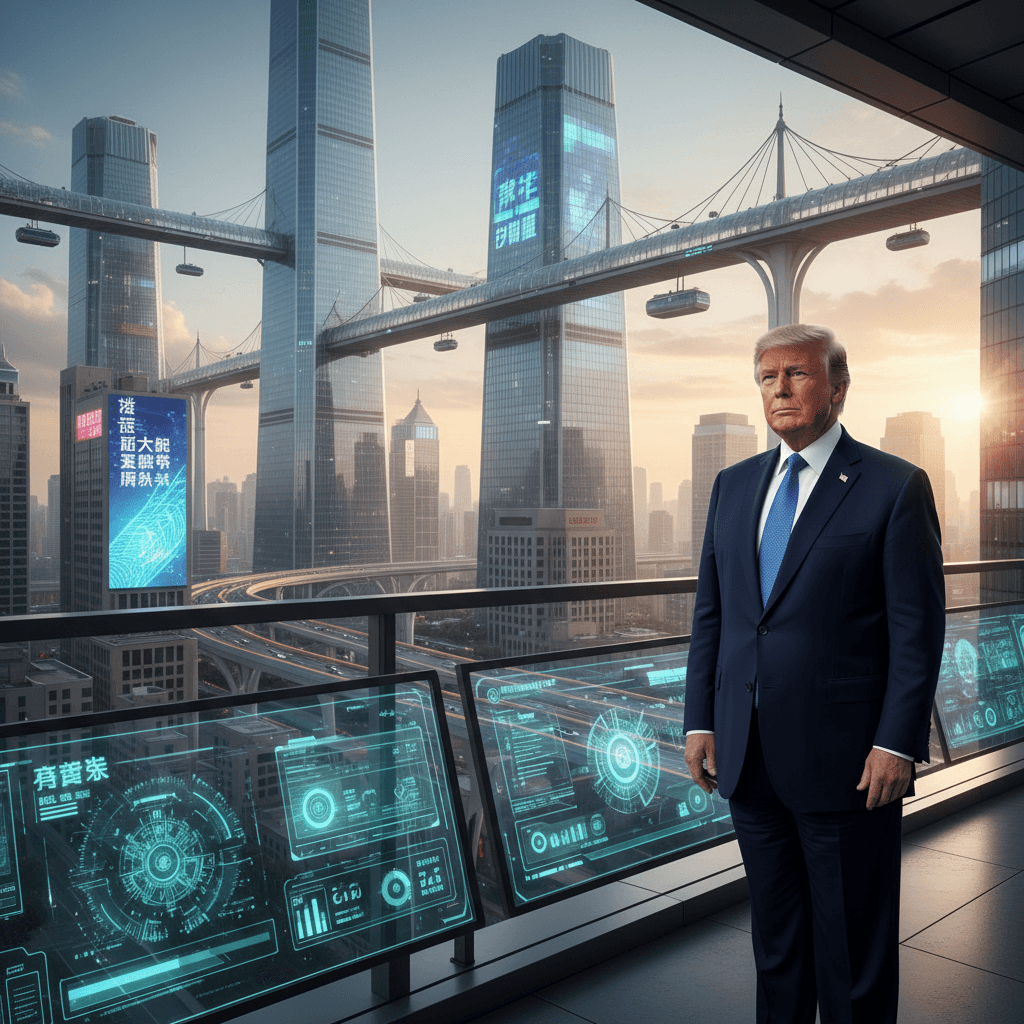
Beijing's transformation into a high-tech metropolis has been years in the making, culminating in the carefully curated spectacle of 2026. The city's avenues now feature an array of autonomous vehicles, from sleek electric buses seamlessly integrated into public transit to delivery drones efficiently navigating urban canyons. State-of-the-art sensors monitor traffic patterns, optimizing routes and reducing congestion, while intelligent streetlights adapt to pedestrian movements, conserving energy and enhancing safety. This orchestrated display of technological prowess aims to showcase Beijing as a beacon of innovation, a city where cutting-edge technology is seamlessly integrated into everyday life. The message is clear: China is not just keeping pace, but actively shaping the future of urban living. This is a carefully orchestrated event to display dominance. The integration of these technologies is more than just a superficial display. The city's infrastructure is managed by sophisticated AI algorithms, optimizing everything from energy consumption to waste management. Smart grids predict and respond to fluctuations in demand, ensuring a stable and efficient power supply. Advanced surveillance systems, powered by facial recognition technology, enhance security and streamline law enforcement. The city's commitment to data-driven governance is evident in every aspect of its operations. Even the once-ubiquitous smog has been significantly reduced, thanks to stringent environmental regulations and advanced pollution monitoring systems. Beijing is becoming the ultimate 'smart city'. This technological showcase is not just for domestic consumption; it is carefully crafted to capture the attention of the global community. International delegations, journalists, and technology experts have been invited to witness firsthand Beijing's transformation. Guided tours highlight the city's achievements, showcasing the seamless integration of advanced technology into the daily lives of its residents. The narrative is carefully controlled, emphasizing China's commitment to innovation, sustainability, and global collaboration. This is a calculated attempt to reshape perceptions of China and its role in the 21st century. It represents a strategic shift in public diplomacy. The timing of this technological spectacle is also significant. Coming just months after President Trump's re-election, it serves as a direct counterpoint to his 'America First' agenda. While the US under Trump is focused on protectionist policies and inward-looking strategies, Beijing is projecting an image of openness, innovation, and global leadership. This juxtaposition is not accidental; it is a deliberate attempt to position China as the responsible superpower, a nation committed to addressing global challenges and promoting international cooperation. The global stage is set, and the spotlight is firmly on Beijing. The contrast could not be clearer.Trump's Shadow: A Contrasting Vision
The resurgence of President Trump's influence on the global stage casts a long shadow over Beijing's technological ambitions. His administration's 'America First' policies, characterized by protectionism, trade wars, and skepticism towards international cooperation, stand in stark contrast to China's outward-facing approach. Trump's emphasis on domestic manufacturing and job creation, while appealing to his base, has alienated many international allies and created uncertainty in global markets. This divergence in ideologies has fueled a growing rivalry between the two superpowers, with technology emerging as a key battleground. The stage is set for intense competition between the two. Trump's skepticism towards climate change and environmental regulations also clashes with Beijing's efforts to promote sustainable development and reduce pollution. While the US has withdrawn from international climate agreements, China has pledged to achieve carbon neutrality by 2060 and is investing heavily in renewable energy technologies. This commitment to sustainability is a key component of Beijing's image as a responsible global leader. Furthermore, Trump's administration has actively sought to restrict Chinese access to advanced technologies, citing national security concerns. This has prompted China to accelerate its own technological development and reduce its reliance on foreign imports. The contrast is very apparent. The 'America First' agenda has also strained relationships with traditional US allies, creating opportunities for China to expand its influence in key regions. By promoting multilateralism, free trade, and international cooperation, Beijing has positioned itself as a more reliable partner for many countries. This has allowed China to forge new economic and political alliances, particularly in Asia, Africa, and Latin America. Trump's inward focus has inadvertently created a vacuum that China is eager to fill. The power dynamic shifts on the world stage. The clash between Trump's protectionist vision and Beijing's global ambitions has profound implications for the future of international relations. The world is witnessing a power struggle between two fundamentally different models of global leadership. The outcome of this competition will shape the economic, technological, and political landscape for decades to come. The world is being divided. The implications are many.Key Technologies on Display: A Glimpse into the Future
At the heart of Beijing's technological showcase lies a carefully curated selection of next-generation technologies, each designed to highlight China's innovative capabilities. Autonomous vehicles are a prominent feature, demonstrating the city's advancements in artificial intelligence, sensor technology, and mapping systems. These vehicles, ranging from self-driving buses to delivery drones, navigate the city's streets with remarkable precision, showcasing the potential of autonomous transportation to revolutionize urban mobility. They represent the future of transport. The precision is amazing. Artificial intelligence is also ubiquitous throughout the city, powering everything from public services to security systems. AI algorithms optimize traffic flow, manage energy consumption, and enhance public safety. Facial recognition technology is used for everything from identifying criminals to streamlining access to public transportation. The seamless integration of AI into daily life underscores China's commitment to data-driven governance. The city is being driven by AI. Beyond transportation and public services, Beijing's showcase also highlights its advancements in renewable energy technologies. Solar panels adorn rooftops across the city, generating clean electricity and reducing reliance on fossil fuels. Smart grids manage energy distribution, optimizing efficiency and preventing blackouts. The city's commitment to sustainability is evident in its efforts to reduce pollution and promote green technologies. Beijing's environment has vastly improved. The change is real. Finally, the showcase also features advancements in communication and connectivity. 5G networks provide lightning-fast internet speeds, enabling seamless communication and data transfer. Advanced cybersecurity systems protect the city's infrastructure from cyberattacks. The commitment to connectivity and security underscores China's ambition to become a global leader in the digital economy. With all these advancements, the city feels futuristic.Global Reactions: A Divided World
Beijing's technological showcase has elicited a range of reactions from around the world, reflecting the growing divisions in the international community. Many countries, particularly those in Asia and Africa, have expressed admiration for China's technological achievements and its commitment to global collaboration. These nations see China as a valuable partner in promoting economic development and addressing global challenges. They admire Beijing's commitment. However, other countries, particularly those closely aligned with the US, have expressed skepticism and concern about China's growing influence. They worry about China's human rights record, its assertive foreign policy, and its potential to use technology for surveillance and control. These nations see Beijing's ambitions as a threat to their own interests and values. The influence may lead to more control. Even within individual countries, opinions on China's technological showcase are often divided. Some see it as a sign of progress and innovation, while others worry about the potential for job displacement and social inequality. These differing perspectives reflect the complex and nuanced relationship between technology, society, and politics. There are many different viewpoints. Ultimately, the global reaction to Beijing's showcase underscores the growing polarization of the international community. The world is increasingly divided between those who embrace China's rise and those who fear it. This division will have profound implications for the future of international relations and the global balance of power. The world is divided into different camps.Economic and Political Implications: A Shifting Balance of Power
Beijing's technological ambitions have significant economic and political implications, signaling a potential shift in the global balance of power. China's rapid technological advancements are transforming its economy, creating new industries and high-paying jobs. This economic growth is fueling its military modernization and its growing influence on the world stage. China is becoming an economic powerhouse. It is happening before our very eyes. China's technological prowess also gives it greater leverage in international negotiations. Its ability to develop and deploy advanced technologies, such as 5G and AI, allows it to set global standards and shape international regulations. This technological leadership is a key component of China's ambition to become a global superpower. It is using its tech power to gain international power. However, China's growing influence also raises concerns about its commitment to international norms and values. Its human rights record, its assertive foreign policy, and its use of technology for surveillance and control have drawn criticism from many countries. These concerns have fueled a growing backlash against China's technological expansion. Not everyone is happy with China's rise. Ultimately, the economic and political implications of Beijing's technological ambitions will depend on how China chooses to use its power. If it embraces international cooperation and adheres to global norms, it could play a constructive role in addressing global challenges. However, if it pursues a more assertive and unilateral approach, it risks alienating other countries and fueling international tensions. China's future will depend on how it uses its power.Future Scenarios: Navigating a High-Tech World Order
Looking ahead, the future of the global order will be shaped by the ongoing competition between the US and China in the technological arena. Several scenarios are possible, each with its own implications for international relations and the global economy. One scenario is a continuation of the current trend, with the US and China competing for technological dominance in a fragmented world order. In this scenario, the two superpowers would continue to pursue their own separate technological agendas, leading to a divided global market and increased tensions. It would be a continuation of the trend. The powers compete. Another scenario is a renewed era of international cooperation, with the US and China finding common ground on key technological issues. In this scenario, the two superpowers would work together to promote innovation, set global standards, and address shared challenges, such as climate change and cybersecurity. This would require a significant shift in mindset from both sides, but it could lead to a more stable and prosperous world order. The two work together. A third scenario is a period of technological decoupling, with the US and China completely separating their technology ecosystems. In this scenario, the two superpowers would create their own independent supply chains, standards, and regulations, leading to a balkanized global technology market. This would have significant economic costs and could further exacerbate international tensions. There would be a complete separation. Ultimately, the future of the global order will depend on the choices made by the leaders of the US and China. By embracing cooperation, promoting innovation, and upholding international norms, they can create a more prosperous and secure world for all. The choices depend on those leaders and will shape the future."Beijing's technology showcase is a calculated move to redefine global leadership. It's not just about the technology itself, but the message it sends: China is ready to shape the future, and that future looks remarkably different from the vision promoted by President Trump."
— Dr. Anya Sharma, Professor of International Relations, GlobalTech University
| Feature | Beijing's Tech Showcase | Trump's 'America First' |
|---|---|---|
| Technological Focus | Autonomous vehicles, AI-driven infrastructure, renewable energy, 5G | Domestic manufacturing, job creation, limited investment in next-gen tech |
| Global Outlook | Promotes global collaboration, multilateralism, free trade | Prioritizes protectionism, trade wars, skepticism towards international cooperation |
| Environmental Policy | Invests in sustainable development, reduces pollution, commits to carbon neutrality | Skeptical of climate change, withdraws from international climate agreements |
| Economic Strategy | Fosters innovation, creates new industries, expands global influence | Focuses on domestic production, restricts foreign access to technology |
| International Relations | Seeks new economic and political alliances, promotes multilateralism | Strains relationships with traditional allies, prioritizes bilateral deals |
| Overall Vision | China takes a technological leadership role | America isolates itself |
Frequently Asked Questions
What specific technologies were showcased in Beijing during the 2026 event, and how do they compare to technological advancements being pursued in other parts of the world, particularly the United States and Europe? Were there any technologies displayed that gave Beijing a clear and demonstrable lead over its global competitors, and what are the factors contributing to that lead?
Beijing's showcase featured an impressive array of technologies, including advanced autonomous vehicle systems, AI-driven infrastructure management, and sophisticated 5G network capabilities. While the United States continues to innovate in areas like AI and biotechnology, Beijing has focused on the practical implementation and large-scale deployment of these technologies. The city's lead in autonomous vehicle deployment, for instance, is driven by a combination of government support, relaxed regulatory environments, and a willingness to embrace data collection on a massive scale. Furthermore, China's rapid progress in renewable energy technologies, particularly solar power, is giving it a competitive advantage in the global green energy market. The focus is more about practicality than abstract, future tech. It's easy to see the results.
How did President Trump and his administration respond to Beijing's high-tech display, and what specific policies or strategies did they implement to counter China's growing technological influence? Did these policies prove effective in curbing China's progress, or did they have unintended consequences that further strengthened China's position in the global tech landscape?
President Trump's administration responded to Beijing's high-tech display with a combination of skepticism and aggressive countermeasures. His administration doubled down on its 'America First' agenda, implementing protectionist policies aimed at restricting Chinese access to advanced technologies and encouraging domestic manufacturing. However, these policies had mixed results. While they may have slowed China's progress in certain areas, they also prompted China to accelerate its own technological development and reduce its reliance on foreign imports. Furthermore, Trump's strained relationships with traditional US allies created opportunities for China to expand its influence in key regions, undermining US efforts to contain China's technological rise. The results were mixed and showed China's resilience.
What were the key takeaways for other nations and global businesses observing Beijing's technological capabilities, and how did this influence their own strategies for innovation, investment, and international collaboration? Did it lead to increased cooperation with China, or did it prompt them to seek alternative partnerships and technological solutions outside of China's sphere of influence?
Beijing's technological showcase served as a wake-up call for many nations and global businesses, prompting them to reassess their own strategies for innovation and investment. Some countries, particularly those in Asia and Africa, were impressed by China's technological achievements and sought to increase collaboration with Beijing. Others, particularly those closely aligned with the US, expressed concerns about China's growing influence and looked to forge alternative partnerships and technological solutions outside of China's sphere of influence. This led to a more fragmented global landscape, with countries and businesses carefully weighing their options and seeking to diversify their technological dependencies. The showcase certainly served as a wake-up call.
To what extent did Beijing's high-tech ambitions reflect broader geopolitical strategies, and how did this showcase contribute to China's soft power projection on the global stage? Did it effectively enhance China's image as a responsible global leader and a reliable partner, or did it reinforce existing concerns about its authoritarian tendencies and its potential to use technology for surveillance and control?
Beijing's high-tech ambitions are deeply intertwined with its broader geopolitical strategies, serving as a key component of its soft power projection on the global stage. By showcasing its technological prowess, China aims to enhance its image as a responsible global leader, a nation committed to innovation, sustainability, and international cooperation. However, this strategy is not without its challenges. China's human rights record, its assertive foreign policy, and its use of technology for surveillance and control continue to raise concerns among some countries, limiting the extent to which Beijing can effectively project its soft power. The effectiveness varies based on the location.
What long-term effects did this event have on the global technological landscape and the balance of power between the United States and China, and what are the key lessons learned for both countries as they navigate the challenges and opportunities of a rapidly evolving high-tech world order? Did it ultimately lead to increased cooperation, heightened competition, or a more fragmented global technology ecosystem?
The long-term effects of Beijing's high-tech showcase are still unfolding, but it has undoubtedly accelerated the ongoing shift in the global technological landscape. It has underscored the importance of investing in next-generation technologies and fostering innovation, while also highlighting the need for international cooperation to address shared challenges. Whether this leads to increased cooperation, heightened competition, or a more fragmented global technology ecosystem remains to be seen, but the event has undoubtedly changed the conversation and set the stage for a new era of technological competition and collaboration. The future remains to be seen, but the world has certainly changed.